Do not confuse heat storage with resistance
Thermal mass describes the ability of material to absorb and release heat. Insulation describes resistance to heat flow. A heavy wall can have substantial heat capacity without providing enough thermal resistance for the project. A lightweight insulated wall may resist heat transfer effectively while storing relatively little energy. These are complementary properties, not a contest with one universal winner.
Mass can moderate indoor temperature swings when its location and the daily climate cycle support that role. It needs a route for releasing accumulated heat. Where nights remain hot, a heavy building can stay uncomfortable after outdoor conditions begin to improve. Internal gains from people, cooking and equipment also matter. Thermal simulations should reflect actual occupancy and operation, rather than an idealized empty room.
Read earth as a family of construction systems
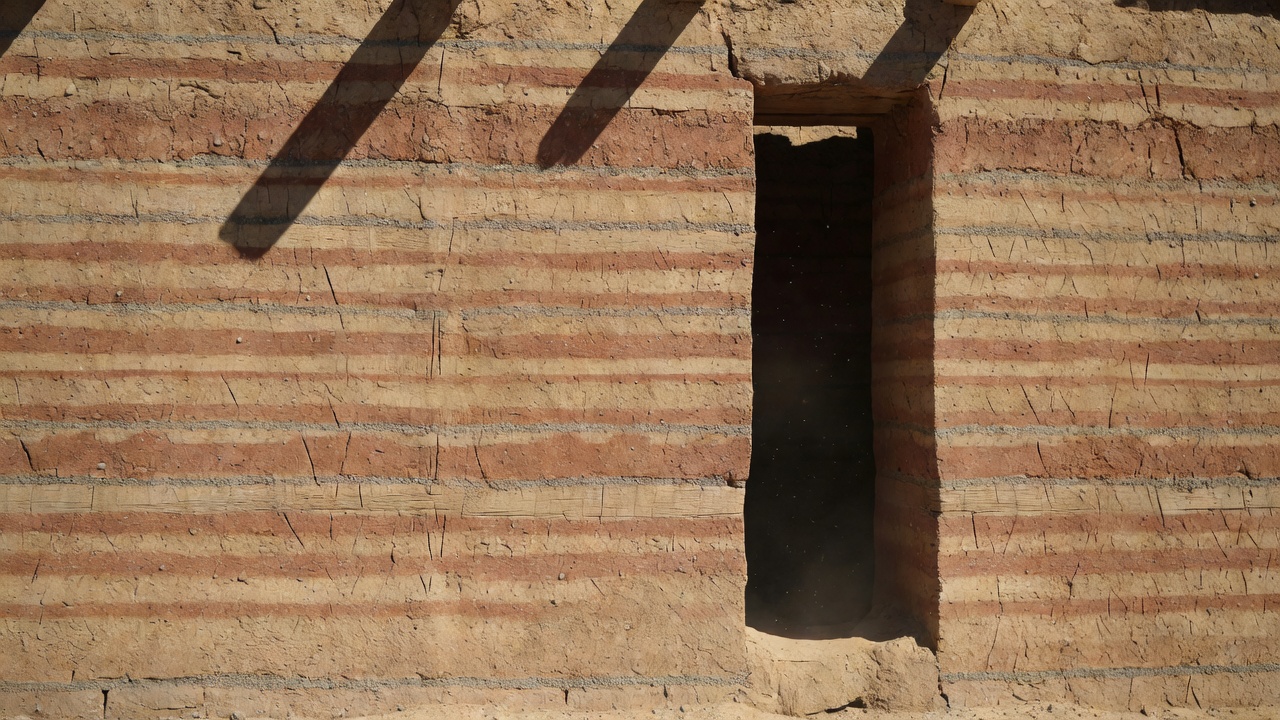
Adobe, rammed earth and compressed earth blocks are not interchangeable products. Soil grading, clay content, compaction, additives and workmanship influence strength and moisture behavior. A locally available soil may need processing or may be unsuitable for a proposed method. Structural design, seismic conditions and code acceptance must be established before assuming that earth is a simple low-technology option.
Water protection is central even in a desert. Short, intense storms, flash flooding, plumbing leaks and moisture rising from the ground can damage poorly detailed construction. Appropriate foundations, capillary breaks, roof edges and compatible finishes protect the assembly. Cement stabilization can change durability and embodied impacts, so “natural” and “low carbon” should not be assigned automatically to every earth-based mix.
Compare assemblies, not isolated samples
A wall is a set of connections: structure, insulation, air control, moisture control, finishes and junctions with roofs and floors. Small discontinuities can undermine a promising material choice. Thermal bridges through structural elements, gaps around frames and poorly fitted roof insulation deserve attention early, when they are easier to resolve. A material specification without construction details is an incomplete performance claim.
Lightweight systems can be useful where fast response, transport constraints or intermittent occupancy matter. Heavy systems may suit other schedules and local craft capabilities. Timber, plant fibers, masonry and manufactured insulation each bring fire, pest, moisture and supply-chain considerations. Ask how the assembly will be inspected and repaired by people who are actually available locally, not only by a specialist installer.
| Option | Potential contribution | Principal checks |
|---|---|---|
| Earthen wall | Thermal storage and local craft | Soil suitability, water protection, structure |
| Stone masonry | Durability and heat capacity | Quarry impacts, weight, thermal resistance |
| Insulated light frame | Heat-flow resistance and quick response | Continuity, fire, moisture, repair access |
| Reflective roof finish | Lower solar absorption | Glare, aging, dust and roof compatibility |
Consider what the sun actually touches
Solar reflectance influences how much incoming sunlight a surface absorbs. Thermal emittance affects how effectively it releases heat as infrared radiation. A pale appearance alone does not fully describe either property. Cool-roof products should be selected using appropriate tested information and local requirements. Dust accumulation, weathering and cleaning practices can change performance over time.
Reflective finishes also affect the surroundings. Bright paving or a highly reflective wall may increase glare or direct radiation toward people and adjacent buildings. Shade can sometimes address the underlying exposure more effectively. Dark surfaces may be visually appealing but require a clear thermal rationale in exposed locations. Surface choice should therefore be tested at the scale of both the room and the outdoor space.
Ask what happens before and after installation
A responsible material comparison includes extraction, production, transport, construction waste, maintenance and eventual reuse or disposal. Environmental product declarations can help describe impacts, but comparisons require compatible boundaries and functional performance. A nearby product is not automatically the lowest-impact option if it fails early or requires an unusually energy-intensive binder. Durability and repairability change the whole-life result.
Request evidence for specific products, verify local availability and include the expected service conditions. Keep a repair record and make vulnerable details accessible. The most useful material decision is rarely the one with the strongest marketing phrase; it is the assembly that meets the project’s thermal, structural and environmental needs with a credible maintenance plan. Pair that decision with shade and a realistic cooling strategy.